
Artificial intelligence is no longer limited to answering questions, writing emails, or helping with homework. Increasingly, people are also turning to AI for emotional support.
Someone might open an AI chatbot after a difficult day, ask for advice about a relationship, write about their worries, or simply have a conversation when they don’t feel like talking to anyone else.
This growing behavior raises an interesting question: Why are people becoming so comfortable seeking emotional support from AI?
The answer isn’t simply that people prefer technology to humans. In many cases, AI fills gaps that already exist in people’s lives—such as limited time, fear of judgment, loneliness, or difficulty finding someone available to talk to.
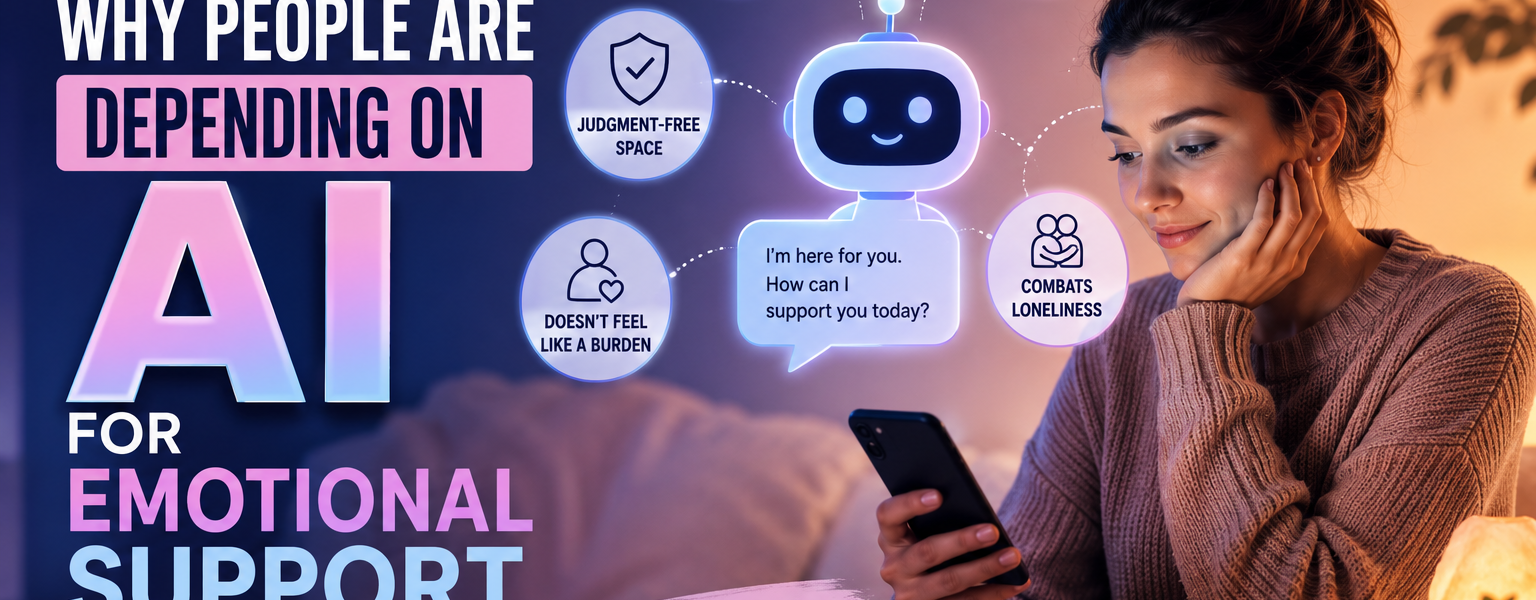
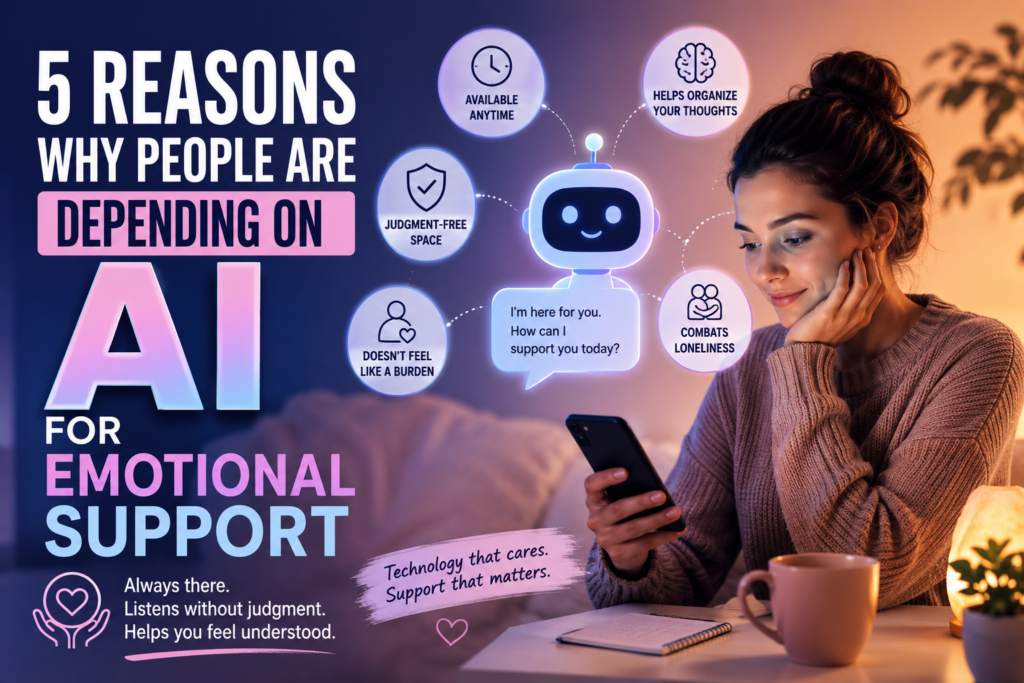
Here are five major reasons behind this shift.
1. AI Is Available Whenever People Need It
One of the biggest reasons people turn to AI for emotional support is simple: availability.
Friends may be working. Family members may be asleep. A therapist may have appointments booked weeks in advance. Even when someone has a strong support network, the right person may not be available at the exact moment they need to talk.
AI, by contrast, can be accessed almost instantly.
Someone feeling overwhelmed at midnight can open an AI chatbot and start typing.
Someone nervous about an important conversation can ask for help organizing their thoughts before going to bed.
That immediate availability can make AI feel convenient and comforting.
Why this matters
Emotional distress doesn’t always happen during convenient hours.
The ability to express thoughts immediately can help some people slow down, organize what they’re feeling, and identify what they actually need.
However, availability should not be confused with professional care. AI can provide conversational support, but it cannot replace a qualified mental-health professional or a trusted human relationship.
2. People Feel Less Judged When Talking to AI
Another major reason for the popularity of AI emotional support is the perception of privacy and reduced judgment.
People often hesitate to share certain thoughts with friends or family because they’re worried about how they’ll be perceived.
They may think:
“What if they think I’m being dramatic?”
“What if they judge my decision?”
“What if they tell someone else?”
“What if they don’t understand?”
Talking to an AI can feel different.
There is no awkward facial expression, uncomfortable silence, or visible reaction. A person can write their thoughts exactly as they come to mind.
For some people, that lower social pressure makes it easier to be honest.
AI can also help people explore difficult thoughts before deciding whether they want to discuss them with another person.
But there is an important limitation
Feeling less judged doesn’t mean an AI understands everything correctly.
An AI can misunderstand context, provide an overly reassuring response, or fail to recognize an important issue. That’s why emotionally significant decisions should not automatically be based on an AI conversation.
3. AI Makes It Easy to Talk Without Feeling Like a Burden
Many people don’t want to repeatedly unload their problems onto friends or family.
They may worry that they’re “too much,” that they’re interrupting someone, or that they’re constantly complaining.
This can lead people to keep their emotions to themselves.
AI can feel like a low-pressure alternative.
Someone can type:
“I had a terrible day.”
Then explain everything that happened.
There is no need to apologize for taking up someone’s time.
This is particularly appealing to people who have difficulty asking for help.
AI can also help someone put vague emotions into words.
For example, a person may initially think:
“I just feel awful.”
After writing about the situation, they may realize:
“I’m actually disappointed because I expected something different.”
That process of putting emotions into words can encourage self-reflection.
4. AI Can Help People Organize Their Thoughts
Emotional problems are often messy.
A person may simultaneously feel angry, disappointed, anxious, confused, guilty, and hopeful.
Trying to explain all of that to another person can be difficult.
AI can act as a conversational sounding board, helping users break a complicated situation into smaller pieces.
For example, someone dealing with a relationship problem might ask:
- What am I actually upset about?
- Am I reacting to what happened or what I expected to happen?
- What are my options?
- How can I communicate this without starting an argument?
- What questions should I ask myself before making a decision?
This can turn an emotional situation into something that feels more manageable.
AI can be useful for reflection
One of the more constructive uses of AI emotional support is structured self-reflection.
Instead of simply asking AI what decision to make, a person can ask it to help identify different perspectives, summarize their concerns, or generate questions they can discuss with someone they trust.
That keeps the human in the decision-making role.
5. Loneliness Is Making Digital Companionship More Appealing
Perhaps the most important reason is loneliness.
People can be surrounded by others and still feel emotionally disconnected.
Modern life can involve remote work, busy schedules, social media interactions, relocation, relationship difficulties, and fewer opportunities for meaningful conversations.
In that environment, an AI conversation can provide a feeling of interaction when someone doesn’t have another person available.
AI companionship can feel particularly appealing because the conversation is interactive rather than passive.
Instead of simply reading an article about loneliness, someone can describe what they’re experiencing and receive a response.
For some users, that interaction can feel comforting.
But this is also where the biggest questions arise.
Is AI Emotional Support Actually Healthy?
The answer isn’t simply yes or no.
AI can have useful applications for emotional well-being, such as helping someone reflect, brainstorm coping strategies, prepare for difficult conversations, or find information.
But depending heavily on AI for emotional support can also create problems.
AI Doesn’t Have Human Relationships
An AI system doesn’t experience friendship, empathy, love, or concern in the same way a human does.
Even when its responses sound warm and understanding, users should remember that the interaction is generated by software.
Human relationships provide something fundamentally different: mutual connection, shared experiences, accountability, and genuine reciprocity.
AI Can Get Things Wrong
AI isn’t infallible.
It can misunderstand a situation, miss important context, reinforce an inaccurate interpretation, or provide advice that isn’t appropriate for a particular person.
This is especially important when someone is dealing with serious mental-health concerns, trauma, abuse, or major life decisions.
Overdependence Can Become a Problem
The biggest concern isn’t necessarily using AI for emotional support.
The concern is when AI becomes someone’s primary or only source of emotional support.
If a person gradually stops talking to friends, avoids professional help, or feels unable to cope without an AI conversation, that may indicate an unhealthy level of dependence.
Technology should ideally complement human connection—not replace it.
The goal doesn’t have to be choosing one over the other.
A healthier approach may be using AI as one tool within a broader support system.
How to Use AI for Emotional Support Responsibly
If you use AI when you’re stressed, lonely, or emotionally overwhelmed, a few boundaries can make the experience healthier.
Use AI as a Thinking Tool
Ask questions that help you understand your situation rather than simply asking AI to make decisions for you.
Instead of:
“Should I end my relationship?”
Try:
“Help me identify the main issues I’m experiencing and questions I should consider before making a decision.”
Keep Human Connections Active
Don’t allow AI conversations to replace conversations with people you trust.
Even a short phone call, walk with a friend, or conversation with a family member can provide something an AI cannot: genuine human connection.
Don’t Treat AI as a Therapist
AI can support reflection, but it shouldn’t be treated as a substitute for qualified mental-health care.
If emotional difficulties are persistent, severe, or interfering with daily life, consider speaking with an appropriate healthcare professional.
Be Careful With Personal Information
Think carefully before sharing highly sensitive personal information with any AI service. Review the service’s privacy practices and understand how your information may be handled.
The Bigger Reason People Are Turning to AI
The rise of AI for emotional support isn’t only a technology story.
It’s also a story about modern emotional needs.
People want to be heard.
They want immediate support.
They want somewhere to put their thoughts when their mind feels crowded.
They want advice without feeling embarrassed.
And sometimes, they simply don’t want to feel alone.
AI happens to be extremely good at being available.
But availability isn’t the same thing as human connection.
The most useful way to think about AI emotional support may therefore be as a bridge—not a replacement.
It can help someone organize their thoughts before talking to a friend.
It can help them identify questions to discuss with a therapist.
It can help turn a confusing feeling into words.
And it can provide a moment of reflection when someone needs to pause.
But meaningful relationships still require people.
Final Thoughts
The growing use of AI for emotional support makes sense when you consider how accessible, private, responsive, and convenient AI can be.
People are turning to AI because it is available when they need it, feels less judgmental, doesn’t make them feel like a burden, helps organize complicated thoughts, and can provide a sense of companionship when they’re lonely.
The important question isn’t whether people should ever use AI for emotional support.
It’s how they use it.
Used thoughtfully, AI can be a useful tool for reflection and emotional self-awareness. Used as a complete replacement for human relationships or professional support, it can create new risks.
The healthiest approach is simple:
Use AI to help you understand your thoughts—but don’t forget to talk to real people about your life.
Human connection remains something technology can simulate in conversation, but cannot truly replace.