Melinda French Gates’ Best Mental Health Advice: “Take Time in Quiet”

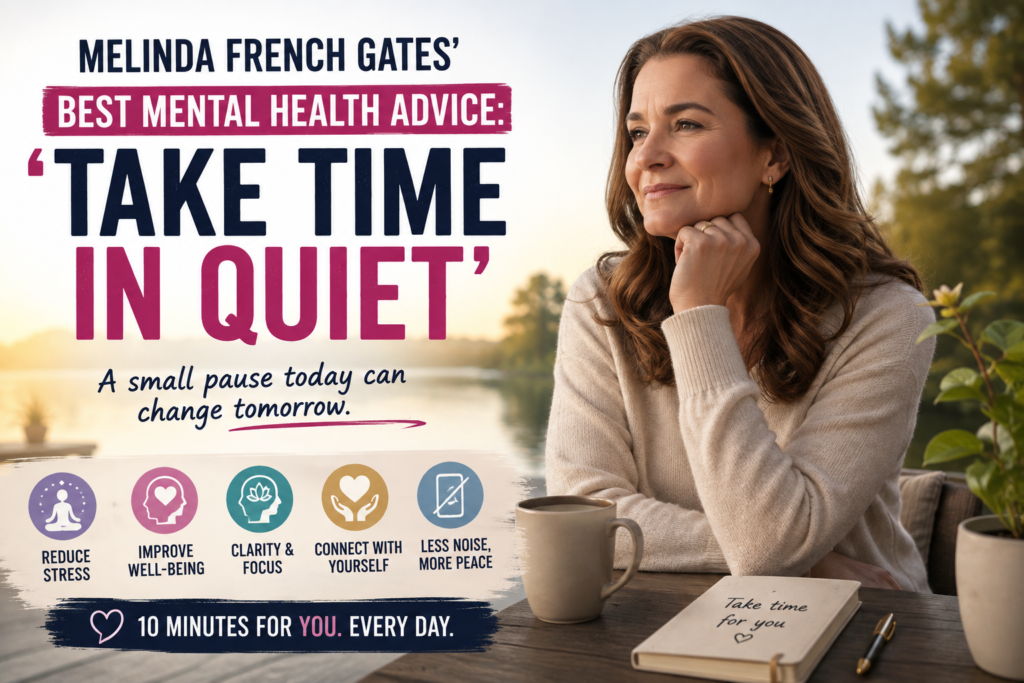
In a world filled with notifications, deadlines, social media, messages, and constant demands for our attention, Melinda French Gates has a surprisingly simple piece of mental health advice: “Take time in quiet.”
Her suggestion isn’t about completely escaping responsibilities or spending hours meditating. Instead, she encourages people to put down their phones, step away from the noise, and give themselves a small amount of uninterrupted time each day.
In interviews discussing her book The Next Day: Transitions, Change, and Moving Forward, French Gates has emphasized finding 10 minutes a day for self-care. She has described using that time for activities such as meditation, jogging, or simply creating space to think.
Her advice is particularly relevant today because many people are physically exhausted but mentally overstimulated.
Sometimes, the thing we need most isn’t another productivity hack.
It may simply be a few quiet minutes with ourselves.
What Does “Take Time in Quiet” Actually Mean?
When French Gates talks about taking time in quiet, she isn’t necessarily saying that everyone needs to sit perfectly still and meditate.
The idea is broader.
It means intentionally creating a short period without constant digital stimulation, conversations, work demands, or distractions.
That could mean:
- Sitting quietly with your morning coffee
- Taking a walk without your phone
- Meditating for 10 minutes
- Writing in a journal
- Sitting outside in nature
- Going for a quiet jog
- Simply breathing and allowing your thoughts to settle
French Gates has explained that she tries to take time in quiet, including spending time outdoors and walking in nature.
The important part is intentional space.
You’re not filling every empty minute with scrolling, checking messages, watching videos, or completing another task.
You’re allowing yourself to simply be.
Why Quiet Time Can Be So Powerful
Modern life rarely gives us genuine mental silence.
Even when we’re physically resting, our minds may still be processing emails, social media posts, work problems, family responsibilities, news, and tomorrow’s to-do list.
Constant stimulation can make it difficult to notice what we’re actually feeling.
Quiet time creates an opportunity to pause.
That pause can help you recognize thoughts that have been buried underneath the noise.
You might suddenly realize:
“I’m not actually angry. I’m exhausted.”
Or:
“I’ve been saying yes to things I don’t really want to do.”
Or:
“I need to have a conversation I’ve been avoiding.”
This is one reason French Gates connects quiet time with listening to your inner voice.
In an interview about The Next Day, she described learning as a student to sit in quiet and reflection, and later found that putting down her phone and spending time alone helped her reconnect with that inner voice.
1. Quiet Gives Your Brain a Break From Constant Stimulation
Think about how often you reach for your phone.
You wake up and check notifications.
You eat while watching something.
You wait in line while scrolling.
You sit down and immediately open an app.
Before long, there may be very few moments when your brain isn’t receiving new information.
Quiet time interrupts this cycle.
You don’t necessarily have to accomplish anything during those minutes.
That’s the point.
Instead of consuming information, you allow yourself to process it.
2. It Can Help You Notice What You’re Feeling
One of the biggest problems with emotional overwhelm is that we don’t always recognize what’s happening until we’re completely exhausted.
We may continue working, answering messages, caring for others, and moving through our routine while ignoring our own emotional signals.
Quiet creates space to check in with yourself.
Ask:
How am I actually feeling today?
What is taking up most of my mental energy?
What do I need right now?
Is there something I’ve been avoiding?
You don’t have to immediately solve the answers.
Simply noticing them can be valuable.
3. Quiet Time Can Support Better Decision-Making
When you’re constantly surrounded by opinions and information, it can become difficult to determine what you actually think.
Social media tells you what you should want.
Other people tell you what you should do.
Your notifications tell you what needs your attention.
Your schedule tells you where you need to be.
Quiet gives you an opportunity to ask:
“What do I want?”
This is particularly useful during major life transitions.
French Gates has spoken extensively about transitions in The Next Day, including the difficult period following her divorce from Bill Gates. She has encouraged people experiencing major changes not to immediately rush into the next phase, but to spend time thinking, feeling, and learning from the transition.
That doesn’t mean staying stuck.
It means giving yourself enough space to understand what happened before deciding where to go next.
4. You Don’t Need an Hour of Self-Care
One of the most practical aspects of French Gates’ advice is its simplicity.
She recommends finding around 10 minutes a day for yourself, but she has also emphasized doing what you can rather than worrying about doing something perfectly. In an interview, she noted that even if someone has only a few minutes available, they can use that time.
That’s an important distinction.
Self-care doesn’t have to look like a luxurious spa day.
It doesn’t require an expensive subscription.
It doesn’t require an hour-long morning routine.
You can start with:
5 minutes.
Then perhaps:
10 minutes.
The goal is to create a repeatable habit.
5. Quiet Can Help You Reconnect With Yourself
Perhaps the deepest part of this advice is that quiet isn’t simply about relaxation.
It’s about self-awareness.
When you constantly listen to everyone else, it can become difficult to hear yourself.
What are your priorities?
What matters to you?
What are you tolerating?
What do you want to change?
What makes you feel energized?
What keeps draining you?
Quiet doesn’t automatically answer these questions.
But it gives you enough space to start asking them.
French Gates has described writing down what her inner voice was saying, talking with close friends, and working with a therapist as ways of reconnecting with herself.
That highlights an important point: quiet time doesn’t have to happen in isolation forever.
Sometimes reflection helps you identify what you need to discuss with someone else.
A Simple 10-Minute Quiet-Time Routine
Want to try the habit yourself?
You don’t need a complicated routine.
Minute 1: Put Your Phone Away
Turn off notifications and place your phone somewhere out of reach.
The goal is to remove the temptation to immediately fill the silence.
Minutes 2–4: Breathe
Sit comfortably.
Take slow, natural breaths.
Don’t worry about achieving a particular meditation state.
Simply notice your breathing.
Minutes 5–7: Check In With Yourself
Ask:
What am I feeling right now?
Don’t judge the answer.
If you’re stressed, acknowledge it.
If you’re tired, acknowledge it.
If you’re happy, acknowledge that too.
Minutes 8–10: Ask One Question
Choose one question:
What do I need today?
or
What deserves my attention right now?
or
What can I let go of?
Write down whatever comes to mind.
There is no requirement to produce a profound answer.
What If You Don’t Like Meditation?
That’s completely fine.
“Quiet time” doesn’t have to mean traditional meditation.
French Gates herself has described different forms of self-care, including jogging and spending time in nature.
Try one of these instead:
Take a Quiet Walk
Leave your headphones at home and pay attention to your surroundings.
Notice the trees, sounds, weather, and movement around you.
Sit Outside
Have your morning coffee outdoors without immediately opening your phone.
Journal
Write whatever is on your mind without worrying about grammar or structure.
Stretch
Spend 10 minutes stretching while keeping your attention on your body.
Drive Without Audio
If you’re driving safely and conditions permit, occasionally let the car be quiet rather than automatically turning on a podcast or music.
The activity matters less than the mental space it creates.
“Take Time in Quiet” Doesn’t Mean Isolating Yourself
There’s another important part of French Gates’ philosophy that shouldn’t be overlooked.
Her advice isn’t simply “be alone.”
In an earlier PBS interview, when asked about her go-to mantra for hard times, she answered: “Take time in quiet and then connect with a friend.”
That’s a powerful combination.
First, pause.
Then connect.
Quiet can help you understand what you’re experiencing. A trusted friend can provide perspective, encouragement, and human connection.
This is especially important because self-care shouldn’t become social isolation.
If you’re struggling emotionally, spending time alone can be useful for reflection, but reaching out to supportive people can be equally important.
Quiet Time vs. Scrolling: What Changes?
Consider two versions of the same 10-minute break.
Option A: Digital Break
You sit down and immediately open social media.
You see someone’s vacation.
Then a news story.
Then an advertisement.
Then a short video.
Then another notification.
Ten minutes later, you’ve consumed dozens of pieces of information—but you haven’t necessarily rested.
Option B: Quiet Break
You sit outside.
Your phone is away.
You drink your coffee.
You notice your breathing.
You let your thoughts move without immediately reacting to them.
Ten minutes later, you may not have consumed anything new.
But you may understand yourself a little better.
That’s the potential value of quiet.
What Mental Health Research Says About Self-Care
French Gates’ advice shouldn’t be interpreted as a medical treatment for mental-health conditions.
However, taking time for activities that support well-being is consistent with broader mental-health guidance.
The National Institute of Mental Health highlights practices such as getting enough sleep, staying physically active, eating well, spending time with loved ones, and making time for relaxing activities as ways to support mental health and overall well-being.
Quiet reflection can fit naturally into that broader approach.
But if you’re experiencing persistent sadness, severe anxiety, significant changes in sleep or appetite, or difficulty functioning in everyday life, self-care alone may not be enough. Speaking with a qualified mental-health professional can provide more appropriate support.
The Real Lesson Behind Melinda French Gates’ Advice
The most valuable part of Melinda French Gates’ mental health advice may not actually be the 10-minute number.
It’s the permission to stop.
In a culture that constantly rewards productivity, stopping can feel unproductive.
But you don’t have to be answering an email, exercising, cleaning, learning, or consuming content every minute of the day.
Sometimes your mind needs room to process.
Sometimes you need to hear your own thoughts before hearing someone else’s opinion.
And sometimes the most productive thing you can do is create enough silence to figure out what actually matters.
French Gates’ own reflections on transitions reinforce this idea: difficult periods can contain opportunities for reflection, learning, and growth rather than something we must immediately rush past.
Try the “10 Minutes of Quiet” Challenge
For the next seven days, try this simple experiment.
Every day, spend 10 minutes without your phone or other digital distractions.
You can sit.
Walk.
Journal.
Meditate.
Drink coffee.
Spend time in nature.
Or simply do nothing.
At the end of the 10 minutes, ask yourself:
“What am I noticing that I usually don’t have time to notice?”
Don’t force an answer.
Just pay attention.
After a week, consider whether you feel more aware of your emotions, priorities, stress levels, or needs.
Final Thoughts
Melinda French Gates’ advice to “take time in quiet” sounds almost too simple for a world filled with complicated mental-health challenges.
But that’s precisely what makes it practical.
You don’t need a perfect morning routine.
You don’t need expensive wellness products.
You don’t need an entire day away from your responsibilities.
You can begin with 10 quiet minutes.
Put down your phone.
Step away from the noise.
Breathe.
Listen.
Think.
And give yourself the chance to hear the voice that can easily get lost in the constant noise of everyday life.
As French Gates has put it, her mantra for difficult times is to take time in quiet and then connect with a friend.
Sometimes, taking care of your mental health begins with something remarkably small:
A few quiet minutes that belong entirely to you.
Note: This article is for general educational purposes and is not a substitute for professional mental-health advice or treatment.