
Managing money doesn’t have to mean giving up everything you enjoy. A good budget helps you understand where your money goes, make thoughtful spending decisions, prepare for unexpected expenses and work toward your financial goals.
Whether you earn a regular salary, manage a household budget or want to stop living paycheck to paycheck, learning to manage your money is an important first step toward financial stability.
In this guide, you’ll learn how to create a realistic budget, reduce unnecessary expenses and develop a savings routine you can maintain over time.
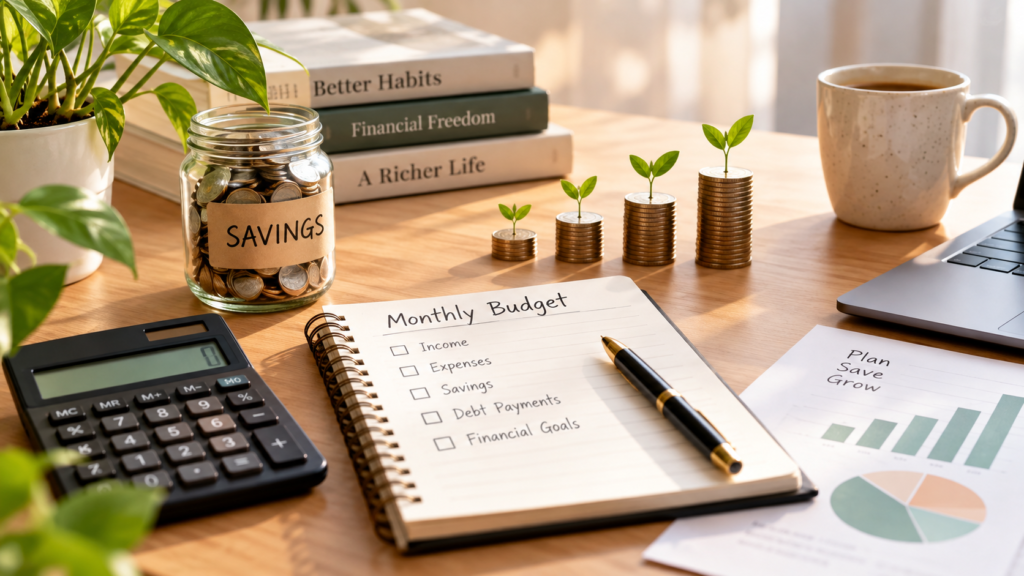
1. Understand Your Current Financial Situation
Before changing your spending habits, understand your current financial position.
Start by identifying three things:
- Income: Your monthly take-home salary and any additional income.
- Expenses: Rent, groceries, utilities, transport, subscriptions, shopping and other spending.
- Financial obligations: Loan EMIs, credit card payments, insurance premiums and other commitments.
Review your bank statements and payment records from the previous two or three months. This will help you identify recurring expenses and spending patterns you may have overlooked.
Calculate your monthly balance:
Monthly balance = Total take-home income − Total monthly outgoings
For example, if your take-home income is ₹60,000 and your total monthly outgoings are ₹52,000, your remaining balance is ₹8,000.
The next step is to decide how much of that amount you can save while maintaining a reasonable financial buffer.
2. Separate Needs, Wants and Financial Goals
Not every expense serves the same purpose. Categorizing your spending makes it easier to identify where adjustments are possible.
Needs
These are essential expenses such as:
- Basic groceries and household supplies
- Housing and electricity
- Essential transportation
- Necessary healthcare
- Minimum required debt payments
Wants
These are discretionary expenses that improve your lifestyle but can often be adjusted:
- Restaurant meals and food delivery
- Entertainment subscriptions
- Impulse purchases
- Frequent shopping
- Nonessential upgrades
Financial goals
These are amounts you set aside for future needs, such as:
- Emergency savings
- Debt repayment beyond required payments
- Retirement planning
- Education and major purchases
- Long-term investments, when appropriate for your circumstances
You don’t need to eliminate every want. Instead, decide which purchases genuinely add value to your life and which ones you can reduce.
3. Choose a Budgeting Method
There is no single budgeting method that works for everyone. Choose one that fits your income, responsibilities and financial goals.
The 50/30/20 budgeting rule
This method divides your take-home income into three broad categories:
- 50% for needs
- 30% for wants
- 20% for savings and debt repayment
For a monthly take-home income of ₹50,000, the suggested allocation would be:
| Category | Amount |
|---|---|
| Needs | ₹25,000 |
| Wants | ₹15,000 |
| Savings and debt repayment | ₹10,000 |
These percentages are guidelines, not strict rules. If your housing expenses or EMIs are high, you may need a different allocation.
The zero-based budget
With this approach, you assign a purpose to every rupee of your income.
For example, your income might be allocated to housing, groceries, EMIs, savings, transportation and personal spending until the full amount is accounted for.
Zero-based budgeting doesn’t mean spending all your money. Savings and investments can also be budget categories.
The pay-yourself-first method
With this method, you set aside a predetermined savings amount as soon as your salary arrives. You then plan your expenses using the remaining money.
This approach can help people who find it difficult to save whatever is left at the end of the month.
Which method should you choose? Start with the simplest one you can maintain consistently. You can always adjust it after tracking your spending for a month.
4. Create a Realistic Monthly Budget
A budget should reflect your actual financial responsibilities, not an idealized version of your life.
Follow these steps:
- Write down your monthly take-home income.
- List all fixed expenses, including rent, EMIs and insurance.
- Estimate variable expenses such as groceries, electricity and transport.
- Decide how much you want to save.
- Set a reasonable limit for discretionary spending.
- Review your budget at the end of each month.
For example, consider a person earning ₹50,000 per month.
| Budget category | Monthly allocation |
|---|---|
| Housing and utilities | ₹12,000 |
| Groceries and household needs | ₹8,000 |
| Transportation | ₹3,000 |
| EMIs and debt payments | ₹8,000 |
| Healthcare and insurance | ₹3,000 |
| Personal and discretionary spending | ₹5,000 |
| Savings | ₹8,000 |
| Other expenses and buffer | ₹3,000 |
| Total | ₹50,000 |
This is an illustrative budget, not a recommended allocation for everyone. Adjust the amounts to your real obligations and local costs.
If your essential expenses already exceed these proportions, don’t force the numbers. Focus on understanding your cash flow, avoiding new unnecessary debt and identifying realistic opportunities to improve it.
5. Reduce Expenses Without Feeling Deprived
Small recurring savings can make a meaningful difference over time.
Try these practical changes:
- Review subscriptions and cancel services you rarely use.
- Plan meals and grocery shopping before visiting the store.
- Compare prices before making significant purchases.
- Set a waiting period before buying nonessential items.
- Reduce food delivery if it is a frequent expense.
- Use a shopping list to avoid unplanned purchases.
- Compare mobile, internet and insurance costs when renewal is due.
- Set a weekly limit for discretionary spending.
For example, suppose you reduce food delivery by ₹1,000, unused subscriptions by ₹300 and impulse shopping by ₹700 each month.
Your potential savings would be ₹2,000 per month, or ₹24,000 over a year, assuming those reductions are maintained.
The aim isn’t to make every day restrictive. It’s to spend more intentionally on the things that matter to you.
6. Make Saving Money a Routine
Saving becomes easier when it is part of your financial system rather than a decision you must make every day.
Consider the following habits:
Automate transfers. Arrange a recurring transfer to a suitable savings account after payday, provided your essential bills and required payments are covered.
Use separate savings goals. Keep track of emergency savings, planned purchases and other goals separately in your budget.
Start with a manageable amount. If you can initially save only ₹500 or ₹1,000 per month, begin there and increase the amount when your circumstances permit.
Review progress monthly. Compare the amount you intended to save with the amount you actually saved.
Increase savings when income rises. When you receive a raise or finish paying an EMI, consider directing part of the additional cash flow toward your financial goals.
Consistency is more important than choosing an ambitious target that becomes impossible to maintain.
7. Build an Emergency Fund
Unexpected expenses can disrupt even a well-planned budget. An emergency fund helps cover costs such as urgent repairs, essential medical expenses or a temporary loss of income without immediately relying on expensive borrowing.
Start by calculating your essential monthly expenses.
If your essential expenses are ₹25,000 per month, a reserve covering three months would be ₹75,000, while six months would be ₹1,50,000.
The appropriate target depends on factors such as job stability, dependants, health needs, debt obligations and access to other financial resources.
You don’t need to save the entire amount immediately. Build the fund gradually and keep emergency money accessible and in an appropriately low-risk place.
Keep it separate from the money you use for everyday spending so that it is less tempting to use for nonessential purchases.
8. Manage Debt and Monthly EMIs
Debt payments can limit how much money you have available for savings and other goals.
Start by listing each loan or credit balance, its outstanding amount, interest rate, minimum payment and due date.
Then:
- Pay required instalments on time.
- Avoid taking on additional debt for nonessential spending.
- Review interest rates and applicable charges before considering refinancing.
- Direct additional repayments toward high-interest debt when appropriate.
- Avoid using all your available cash to repay debt if doing so would leave you unable to meet essential expenses.
If your EMIs consume most of your take-home income, a conventional budgeting rule may not work. Focus first on essential expenses, required repayments and a realistic cash-flow plan.
For guidance, read our related article: How to Save Money When Most of Your Salary Goes to EMIs.
9. Avoid Common Budgeting Mistakes
Even a good plan can fail if it is too complicated or unrealistic.
Setting an unrealistic savings target
Trying to save a large percentage of your income immediately can leave you short of money for essentials. Start with an achievable amount and increase it gradually.
Ignoring irregular expenses
Annual insurance premiums, school fees, repairs and festival expenses can disrupt your monthly budget. Estimate these costs and set aside money for them over time.
Forgetting small purchases
Frequent low-cost purchases can add up. Track them for a month before deciding whether they need to change.
Treating every unexpected expense as a failure
Budgets are estimates. If a genuine unexpected expense arises, adjust your plan instead of abandoning it.
Never reviewing the budget
Your expenses and priorities change. Review your budget monthly and revise it when your income or responsibilities change.
10. Follow a Simple 30-Day Money Plan
You don’t need to change everything at once. Use the following four-week plan to build a foundation.
Week 1: Understand your money
- Record your income and expenses.
- Review recent bank and payment statements.
- Identify your largest spending categories.
Week 2: Build your budget
- Choose a budgeting method.
- Set limits for discretionary spending.
- Select a realistic initial savings target.
Week 3: Make adjustments
- Cancel unused subscriptions.
- Plan groceries and other regular purchases.
- Set up an automatic savings transfer if affordable.
Week 4: Review and improve
- Compare planned spending with actual spending.
- Identify what worked and what didn’t.
- Adjust your budget for the following month.
At the end of 30 days, your goal is to have a clearer understanding of your money and a budgeting routine you can continue.
Frequently Asked Questions
How much of my salary should I save every month?
There is no universal percentage. The 50/30/20 rule suggests setting aside 20% for savings and debt repayment, but your appropriate target depends on your income, essential expenses and financial obligations. Start with what is sustainable.
How can I save money on a low salary?
Track your spending, prioritize essential needs, reduce avoidable recurring expenses and set aside a manageable amount regularly. If most of your income is already committed to essentials, improving income or reviewing major expenses may be more effective than cutting small purchases alone.
Should I save money or repay debt first?
Continue making required debt payments. Beyond that, consider the interest rate on your debt, whether you have an emergency reserve and the consequences of unexpected expenses. High-interest debt often deserves priority, but keeping some accessible savings can help prevent further borrowing.
What is the easiest way to stick to a budget?
Choose a simple budgeting method, automate savings where practical, track spending regularly and review your results once a month. A flexible budget is usually easier to maintain than one that restricts every purchase.
How do I stop spending more than I earn?
Identify the categories causing overspending, set realistic limits and avoid relying on credit for everyday purchases you cannot afford. If essential costs exceed your income, examine larger commitments and available ways to improve cash flow.
Managing money is not about depriving yourself of everything you enjoy. It is about making deliberate choices so that your income supports both your present needs and your future goals.
Start by understanding your expenses, choosing a budgeting method and setting a realistic savings target. Build an emergency fund gradually, review debt obligations and adjust your plan as your circumstances change.
You don’t need a perfect budget. You need a practical system that helps you make better financial decisions month after month.
Explore more from The Prime Chronicle:
- How to Save ₹10,000 a Month Without Feeling Deprived
- How to Create a Monthly Budget That Actually Works
- How to Build an Emergency Fund From Zero
- How to Stop Impulse Buying and Emotional Spending
- How to Save Money When Most of Your Salary Goes to EMIs